
I spend most of my days in a world of precise measurements, chemical reactions, and the steady hum of a classroom. As a chemistry lecturer, I am used to things having a specific structure. You follow a formula, you observe the reaction, and you reach a conclusion. My life has always been about logic and teaching others how the physical world works. But even when your life is full of science, there is often a quiet space that only music can fill.
I have always loved music, but for a long time, I was just a listener. I didn't think of myself as someone who would eventually pick up an instrument. Then, one day, I was browsing on the internet and a video advertisement popped up. Usually, I skip these things, but this time I stopped. It was Harsh Dave sir playing the flute.
There was something about the sound that hit me immediately. It wasn’t just the melody; it was the way the notes seemed to float. It didn’t feel like a digital recording; it felt like something alive. I sat there and watched the whole thing. In that moment, something shifted inside me. I didn’t just want to listen anymore. I wanted to know how to make that sound myself. I felt an instant inspiration, the kind that doesn’t leave you alone until you do something about it.
When I first held the flute, I realized very quickly that my background in chemistry wasn’t going to help me here. In the lab, if you follow the steps, the experiment works. With the flute, I followed the steps, but all I got was the sound of rushing air. It was a very humbling experience.
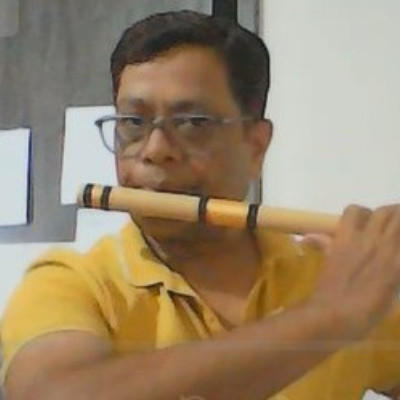
The hardest part for me, the part that required more patience than I thought I had, was the combination of fingering and breath. In the beginning, it feels like your brain is being pulled in two different directions. I had to focus on the placement of my pads on the holes, ensuring there were no leaks, while simultaneously trying to control a steady, thin stream of air from my lungs. If my fingers were right, my breath was too weak. If my breath was strong, my fingers would slip.
There were many days after a long day of lecturing when I would sit down to practice and feel completely defeated. My hands felt clumsy. My lungs felt tired. I would look at the flute and think that perhaps I had started something I couldn't finish. I think everyone who learns an instrument hits that wall where the gap between what you hear in your head and what comes out of the instrument feels too wide to cross.
Whenever I felt like putting the flute back in its case for good, I would go back to that original inspiration. I would listen to Harsh Dave sir play. I would hear that melody—that specific, sweet resonance—and it would remind me why I started. I told myself that the sound existed, which meant it was possible. I just hadn't found the right "formula" for it yet.
I treated my practice like a slow experiment. I stopped worrying about playing whole songs and started focusing on just one clear note. I practiced my scales over and over. I stopped rushing. As a teacher, I tell my students all the time that you cannot understand complex organic chemistry until you master the basics. I had to start following my own advice.
The change didn't happen overnight. It was very gradual. But one day, I noticed that I wasn't thinking about my fingers as much. They started to find their places naturally. And the sound—that was the biggest surprise. As I practiced more and more, the tone changed. It stopped being airy and sharp. It became pleasing. It became something I actually wanted to listen to.
That was the turning point for me. When you finally produce a sound that is beautiful, the struggle of the previous months seems to fade away. The flute has given me a sense of peace that I didn't expect. When I am playing, I am not thinking about my lectures or my responsibilities. I am just in the moment, focused on the breath and the vibration of the wood.
If I could speak to someone who is in the middle of that struggle right now—someone who is frustrated because their fingers won't move right or they keep running out of breath—I would tell them quite simply: please don’t quit.
It is easy to stop when things are hard. It is easy to say you aren't "musical" enough. But the reward for staying with it is so much greater than the comfort of quitting. Keep trying, even if it’s just for ten minutes a day. The transition from noise to music is one of the most rewarding things you will ever experience.
My life is still full of chemistry and formulas, but now, there is a melody running through it as well. I am glad I didn't skip that ad, and I am even more glad I didn't put the flute down when it got difficult.
— Pushpa B.R Karnataka, India
Begin your own flute journey
Join the free live classDid this story stir something within you?
If even one line warmed your heart — carry that spark forward. A small act of sharing keeps the flame alive in someone else.
Reflections
- Be the first to reflect on this story.
A flame waits to be opened
Filling the Quiet Spaces with Music
 by Sheel Kumar Srivastava