
Being a homemaker, my life has always been defined by a certain kind of quiet structure. I’ve always been the type of person who loves to dive deep into things. If I am interested in a subject, I don’t just skim the surface; I spend hours reading, researching, and studying. For a long time, my world was built of books and the steady rhythm of taking care of my home. My days were spent looking for answers in pages and keeping everything in its right place. It was a peaceful life, but in some ways, I think I was looking for something that books couldn't give me—something that lived in the air rather than on paper.
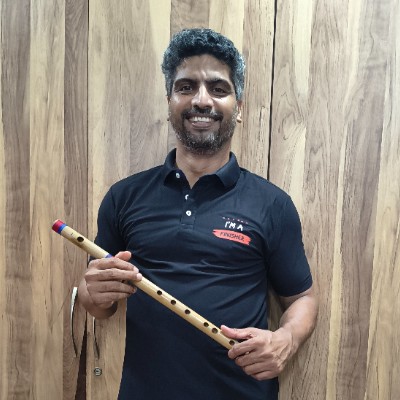
I never really planned on becoming a musician. To be honest, the flute always seemed like something for experts, something far out of reach for someone like me. But then I saw an orientation session with Harsh Sir. He did something I didn’t expect: he made the flute look absolutely simple. Watching him play and explain the instrument, that feeling of "it’s too hard" just evaporated. From that very first day, I was struck by a sense of "wow." He spoke with such encouragement that I felt, for the first time, a sense of "I can do it too."
The journey started with so much excitement. We had lessons three times a week, and there were even bonus practice days. It felt like I had stepped into a new world of sheer happiness. I was eager, I was practicing, and I was ready to conquer this new skill.
But, as it often does, the story changed when we moved from the basic preparations to the side flute. That was where the real struggle began. Suddenly, I wasn't just blowing into a tube; I had to deal with the *taal*—the rhythmic background beat. For a long time, that noise was completely overpowering to me. I couldn't block it out, and I couldn't find my place within it. Instead of being a guide, the beat felt like a distraction that drowned out the sound of my own flute. I couldn’t concentrate. I couldn't hear myself.
While I was struggling with the rhythm, I looked around and saw my fellow students—people who had started at the same time as me—moving forward. They were progressing to the next levels, and I felt stuck. It was a very depressing time. I felt like I was being left behind, and my mind started doing what minds do best: it made me feel low. I felt like I wasn't good enough.
Eventually, I had to face the reality that I wasn't ready to move up. Harsh Sir suggested I move back and join another batch to repeat the level. It was a hard pill to swallow. My ego took a bit of a hit, and I felt quite discouraged. On top of that, the live class timings didn't suit my schedule because of the time difference where I live. I truly thought about giving up. I thought maybe I wasn't meant for this.
What saved me during that dark patch was being part of the Diamond program and having one-on-one sessions with Rishabh Sir. Being able to talk to him directly for those fifteen minutes was a blessing. But even more than that, it was a specific piece of music that pulled me back in: Raag Bhopali.
The first time I heard Raag Bhopali, I absolutely fell in love. There was something about the flow of the notes that touched my soul. It is, to me, the most beautiful sound I have ever heard. Before Bhopali, I hadn't been paying much attention to the *Alankars* (the finger exercises). I thought they were just boring drills. But once I heard the melody of Bhopali, everything changed. I realized that if I wanted to play that beautiful Raag, I had to master the exercises first. I stood up on my feet, metaphorically and literally, and told myself, "I must do it for Bhopali."
That was my turning point. I started working on my Alankars with a new purpose. I stopped looking at them as a chore and started seeing them as the stairs that would lead me to that beautiful music.
I still struggled, of course. For those of us learning this way, the process involves recording ourselves and uploading videos for the mentors to review. I can’t tell you how many times I had to re-upload. I would record, feel unsure, delete, and try again. Every time my mentor approved a video, I would have a huge smile on my face and let out a massive sigh of relief.
Through this process, I realized something about myself. I used to be so bent on getting through the exams as fast as possible. I was frustrated and impatient. I wanted to reach the destination immediately. But I remembered something Sadhguru once said: "The journey is more important than the destination."
I decided to stop rushing. I slowed down my pace. I stopped obsessing over the finish line and started focusing on the moment—on the way I adjusted my breath to the background sound of the Taal, and the way my fingers moved during the Alankars. I realized that the flute wasn't just teaching me music; it was teaching me how to handle my own anxiety.
I have always been someone who gets very anxious about the word "exam." Even now, when I have to submit my recordings for the semester, I feel my performance dip because of the pressure I put on myself. If I see a "minus" or a correction from a mentor, I can still feel myself slump a little. But the difference now is that I see these moments as an opportunity to work on myself.
On the first day I held the flute, it was all a "fancy dream." It was all about the "wow factor." Today, when I pick up my flute, I feel much more sober and sincere. It isn’t about looking cool or finishing a course quickly anymore. It’s about a long-term journey of learning.
I am currently elated because I just passed my recent level. I had truly lost all hope at one point, but I kept going. I still have a lot to work on—my blowing technique still isn't perfect, and I still get nervous—but I’m not in a hurry anymore. The flute has given me a way to stay present, to accept where I am, and to find joy in the repetition.
I am so grateful to Harsh Sir and the whole team. They have been like diamonds to me, guiding me when I felt I was lagging too far behind. I'm no longer just a homemaker who reads about life in books; I am someone who is learning to breathe through the music, one note at a time.
— yamini
Begin your own flute journey
Join the free live classDid this story stir something within you?
If even one line warmed your heart — carry that spark forward. A small act of sharing keeps the flame alive in someone else.
Reflections
- Be the first to reflect on this story.
A flame waits to be opened
Late start, real life—beyond office walls, I finally found me.
 by Tarun Bangera