
My days are usually long. I’m a physician, and I run my own hospital here in our town of Tenali. From the moment I walk in until late in the evening, my mind is full. It is full of patients, diagnoses, treatment plans, and the constant hum of responsibility that comes with caring for people. It’s a life I chose and one I am grateful for, but the stress can build up quietly, day after day, until it feels heavy.
For years, my escape was music. In my leisure time, I would put on Ilaiyaraaja’s compositions. His music has a way of finding the quiet places in your mind and giving them space to breathe. I would just listen, letting the melodies wash over me. For a long time, that was enough. But a thought started to grow in my mind. What if I could do more than just listen? What if I could make the music myself? I needed something just for me, something to balance the demands of my profession. I thought picking up an instrument might be the way.
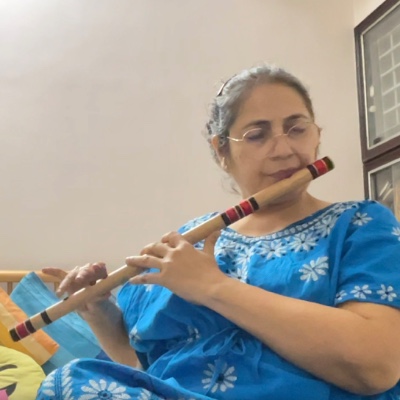
One day, I came across a notice for a free flute class online with a teacher named Harsh Sir. I don’t know why, but I felt a pull. I just signed up. I didn’t have a flute or any idea what I was doing. But in that first class, as I watched and listened, I was captivated. It wasn’t just the sound; it was the way the music seemed to move, to flow. He called it the dance of music, and that’s exactly what it felt like. Something inside me said, “This is it.” And so, my flute journey began.
I wish I could say it was beautiful from the start, but it was not. For the first few months, everything about the flute felt like a language I couldn’t understand. It was like trying to read Greek and Latin. Just to make a clear sound, a single, steady note—that alone felt like a huge mountain to climb. I would take a breath, bring the flute to my lips, and blow. Sometimes, only air would come out. Other times, I would get a shrill, screeching sound that made me wince. I’d try again, focusing on my posture, my lips, everything the teacher said. My breath would run out so quickly. I kept wondering how anyone could hold a note for more than a few seconds.
Then there were my fingers. They felt clumsy and slow. I would look at the notation for a simple scale, and my mind would know where my fingers were supposed to go. But there was a disconnect. My fingers would either not move at all or land on the wrong holes. The coordination between my breath, my lips, and my fingers felt impossible. It was a humbling experience. Here I was, a doctor who used my hands for delicate work, and I couldn't get them to cooperate to play a simple tune.
After a couple of months of wrestling with the basics, a new challenge arrived: *taal*, the rhythm. This was the part that almost broke me. Understanding the beat, the cycle, and how to fit the notes into that framework… my brain just couldn’t grasp it. I would listen to the metronome, that steady tick-tock, and try to play along. But my notes would always be a little too early or a little too late. For three or four months, it was a constant struggle. I felt like I was fighting the music instead of joining it.
There were times, more than a few, when I honestly thought about stopping. I would put the flute down after a frustrating practice session and think, “This is just not for me. I don’t have the talent for this.” The initial joy I had felt was buried under a pile of failure. I was adding more stress to my life, not getting rid of it.
But I didn’t stop. The reason I kept going was the support I had. My mentors and my Guruji, they had a way of reminding me why I started. They didn’t push or criticize. They just kept sharing their love for the music. It was like they injected a bit of their own musical spirit into me when mine was running low. They encouraged me to be patient, to trust the process. That quiet encouragement was the fuel that kept me showing up, day after day, even when I felt like I was getting nowhere.
And then, slowly, things began to change. One day, I was practicing a simple melody with the *taal* track, and for a few seconds, it just… clicked. My fingers, my breath, and the beat were all moving together. It was a small moment, but it was everything. After months of fighting, I was finally starting to dance with the music. Gradually, I became able to hold the notes, to maintain the *sur*, and to stay with different rhythms. The squeaks and hisses were replaced by a sound that was, to my own surprise, sweet and clear.
The flute has given me things I never expected. As a doctor, I thought I understood the body. But learning the flute taught me something new. To sustain the notes and maintain the blowing pressure, I had to learn how to breathe properly, deeply. I can feel that my respiratory capacity has improved. My whole body feels more fit from the simple, consistent effort of playing. There’s a new kind of coordination I feel, a connection between my mind and my muscles that wasn’t there before.
More than that, it has changed how I think. I don’t just hear music anymore; I think about it. I listen for the notes, the melody, the structure. My mind is engaged in a completely new way, a creative way. When I play now, the stress of the hospital melts away. For that half hour or hour, my world is not about sickness and medicine; it’s about sound, melody, and breath. It’s a form of healing for the healer.
This journey has had many ups and downs, and I know there will be more. If you are in the middle of that struggle right now, the only thing I can say is this: be patient. There is no hurry. Let go of the need to be perfect and just start enjoying the sound you are making, whatever it sounds like today. The real reward isn’t playing a perfect song. It’s the quiet way the music works on you while you’re busy trying to work on it.
— EVURU SRIKANTH Tenali, Andhra Pradesh
Watch My Flute Journey
Begin your own flute journey
Join the free live classDid this story stir something within you?
If even one line warmed your heart — carry that spark forward. A small act of sharing keeps the flame alive in someone else.
Reflections
- Be the first to reflect on this story.
A flame waits to be opened
Finding My Breath in the Quiet Moments
 by Sudeshna Banerjee